TGO Challenge applications opened last month, and after a “fallow” year in 2026, I have thrown my hat into the ring for 2027. Whenever I take a year off, the FOMO does tend to strike and consequently I begin thinking about the route for my next one a lot earlier than I would otherwise. Not this has actually helped much this time…

This will be my 7th Challenge, which considering I was only ever going to do it once to “see what all the fuss was about”, is a bit of an overshoot. But the Challenge has become very dear to me, and now that I’m over halfway to a plaque, it doesn’t seem right to stop.
After having done a few crossings, you might think that ideas would be starting to dry up a bit, but each time I do a Challenge, and read or watch other people’s write-ups or videos, I get new ideas. Taken together with all the bits of past routes I didn’t actually do due to taking a FWA, there is plenty of inspiration out there for the next few crossings. The difficulty is actually narrowing down all the possibilities to a single cohesive route.
Lessons from Previous Challenges
2017 when everything was all new, was in many ways the perfect crossing – so perfect in fact that I thought it a fluke and that I would have to do it again to prove it wasn’t! But in reality it wasn’t all perfect: the last drag from the edge of the hills to the coast took a bit of determination, at the exact point that my morale had massively dropped. Day 11 bit me with a deterioration in the weather just when I was on top of a Munro, resulting in me descending (knowingly) to a different glen than I’d planned. It then became one slog to the coast after that. But it had a near perfect actual end with a camp on the beach at Lunan Bay. And the start and middle section were fairly social too.

2018 was the route designed for two that had to be walked solo. It was harder than it should have been. I got ill and nearly pulled out. I got scooped up by other Challengers who I walked with for the rest of the day (Day 11 again). I got a better understanding of the highs and lows of the Challenge.

2019 was actually done as a duo, and at times a trio or even a quartet – so successfully that the 4 of us actually planned our 2020 crossings to be a harmonious set of interconnecting routes giving a mixture of solo and group time and in various combinations. (Then of course that didn’t happen). 2019 was a lesson in the fact that the individuals in your party will have highs and lows at different points, and not even logically. My walking partner hated day 2, but somehow a 38km trudge to beat sunset on day 3, incidentally being the longest day’s walk I’d ever done, rescued his Challenge. My downer was, of course, on day 11 when he was a bit more chipper.

2022 was a year of wanting something too much, after 3 years out of the groove. So desperate was I that the level of expectation I had was never going to be met. It didn’t help that the plan was for a trio, one dropped out at the start, and the two remaining had quite different rhythms and strengths. My remaining teammate preferred a later start and later finish – I liked to get the day’s walk over and done with; I loved a big stretch of road walking in the middle – it nearly crippled my walking partner. The route itself was also ambitious in the conditions, especially at the start, and for much of the crossing we were playing catch-up.

2024 was the long one, but also the first of two very lonely Challenges, with me starting at Kilchoan, then heading even further west, and starting a day later than most people. Only by pure luck did I meet someone on day 6 that I walked with, as even that route was an emergency re-plan due to illness and not feeling like doing the more remote section I had planned. The later stages involved more social settings and a lovely end with the strawberry tarts at Charleton Fruit Farm.
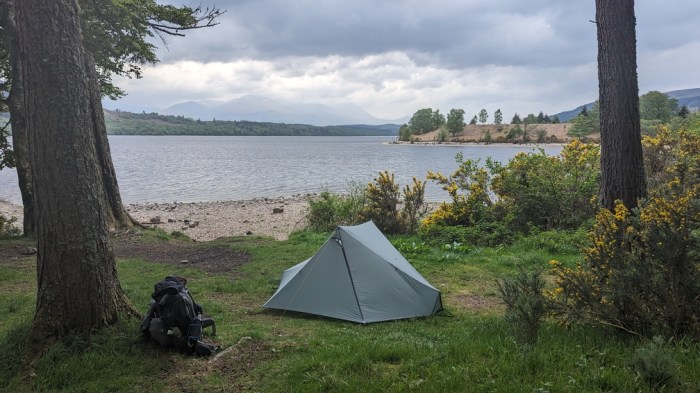
2025 was even lonelier, with an Ardrishaig start, and walking in a completely different direction to the other starters from there. I saw my first fellow Challenger on day 9. I also had some lower leg issues, which I believe were caused by a lack of hiking prep, my zero drop shoes, and the huge amount of running I’d done at the expense of walking.

Taken together, these past Challengers have really made me stop and think this year about what a successful Challenge means to me:
- Understanding when in the walk I tend to experience dips in morale
- Including enough social time, and creating the route accordingly
- Being very clear, even selfish, about who I walk with
- Not every Challenge has to have an epic finale
- I need to find a suitable blend of running and hiking in the lead up that won’t lead to injuries. And not shock my legs/feet with radically different footwear for the two disciplines.
This means that my 2027 crossing will be deliberately more social, particularly at the start and end, with a more grueling solo section in the middle, but that also has plenty of options to scale it back. I wanted it to be decently long too, and have a unique finish point, but I’ve compromised on these due to the experiences of my last 2 Challenges.
How I Planned It
As well as considering the above lessons, I generally impose on myself a few additional constraints:
- I like to make my start point very different from the previous crossing: so if I start south one year, I’ll generally aim to start much further north the next time. And vice versa.
- I make it a rule to finish somewhere different every time, and also try to not replicate any of the previous year’s route, especially around Braemar.
- Now that I’ve got a few crossings under my belt, I like to include a revisit to one or two favourite places to boost morale.
- I usually try to include at least one Munro on my plan, but with the expectation that I’m under no pressure at all to actually climb it. I actually view my FWA as my default route, and anything more intrepid as a Good Weather Alternative (GWA). This helps assuage any guilt about not doing the hills on my routecard.
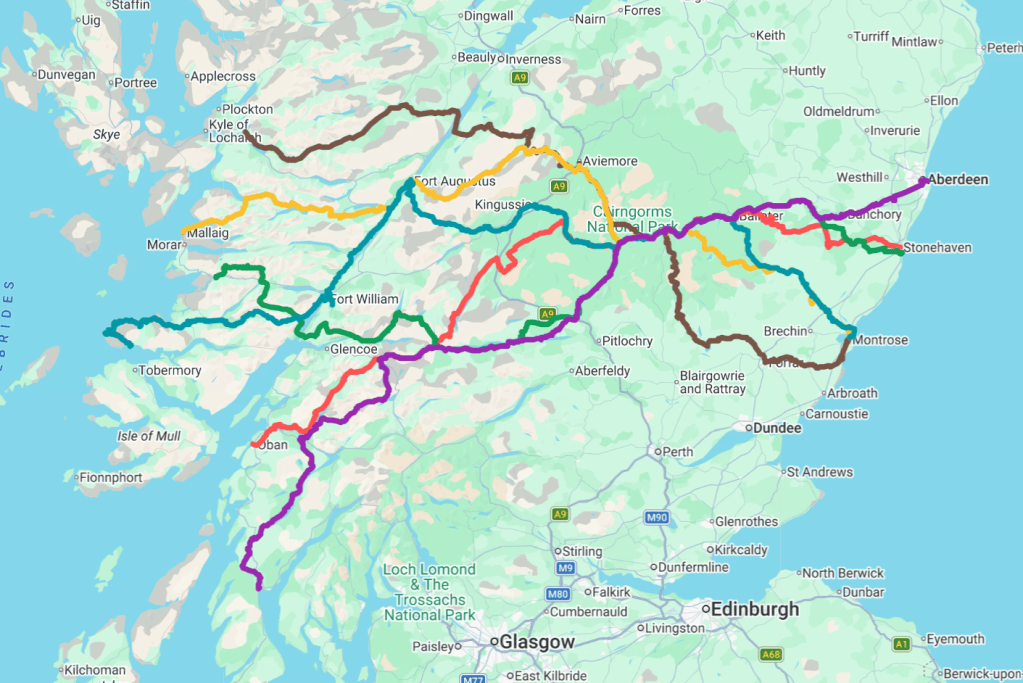
As a result, this time I was looking at a northern start, and this really came down to Shiel Bridge or Strathcarron for me. The finish remained up in the air until the end of the process – first looking at Arbroath, then some special spots nearer Stonehaven, and finally I ended up with St Cyrus to give a more social finish, this being the overriding theme of my 2027 crossing.
Of my favourite places, I tend to reuse several of them simply through my choice of approach to Braemar each time, so I deliberately avoided doing this. As a result I’m including Glen Markie, and reprising one of my favourite camps from my very first Challenge too.
I only added in Munros once I had a base lower-level route and knew how much slack I had to play with. As I will be heading around the northern fringe of the Cairngorms this time, I’m picking off a few that lie very close to that route, which, as always, I can either choose to do or not on the day. As this will deposit me in Ballater and I plan to make this a Tarfside year, a fourth Munro adds itself naturally to the list as the most obvious and straightforward way between these two places goes by way of Mount Keen.
I’ve ended up with a route of 350km and 10,000m of ascent, which overall falls into about the range I was looking for. If I take all my FWAs, I will save about 14km and 1,600m of climbing. I have opportunities to meet other Challengers at Cougie and Cannich (day 2), Drumnadrochit (day 3), Fort Augustus (day 4), Aviemore (day 8), Ballater (day 12), Tarfside and down the North Esk to St Cyrus (days 13-15).
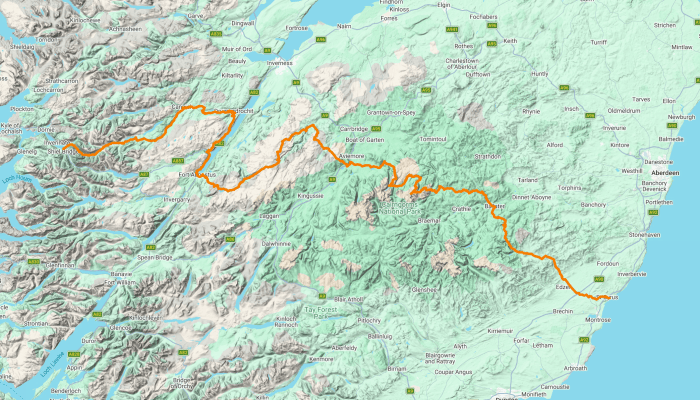
The route has come back from the vetters unscathed apart from a suggested change in phone-in point, which I have adopted. So now I just have to make the rest of the accommodation bookings, plan the logistics and actually prepare body and gear for the event.
Logistics and Gear
Getting to Shiel Bridge will most likely be a matter of a train to Inverness and then a bus to Shiel Bridge, or maybe a bus from Glasgow. Which it is will largely be determined by how I get to Glasgow in the first place from down south.
I’m generally going to use campsites where available, both because other Challengers will be there, and because I don’t feel the need to maximise the number of wild camps like I once would. I am very much going for quality over quantity when it comes to the wild camps this time. I reckon there will probably be 6 wild camps, 6 tame, and a couple of places with actual roofs, as well as staying somewhere the nights before and after the Challenge itself.
With all of the places I’ll be passing through with shops, I may be able to get away without sending myself parcels, and simply “living off the land”. I usually end up carrying more food from home than I eat, so maybe I’ll just keep that as a minimal emergency supply this time.
It’s too early to make firm gear choices, as they will to some extent need to reflect what the weather outlook is, at least for the first few days, which are often the ones with the worst weather anyway. But I’d be surprised if any of the main items differ much from last time – my gear is pretty settled these days. I can see that I may want to take a different tent, having taken the Stratospire on my last two crossings. If I do deviate from what I once described as “the perfect Challenge tent”, it will most likely be my Liteway PyraOmm duo with homemade inner. I will make the decision nearer the time to reflect the estimated conditions and also the spots I’m planning to wild camp.
One thing I do need to do if I take the Stratospire, and arguably even if I don’t take it, is to re-establish confidence in the tent, after that confidence got knocked when I had to bail off a camp on Dartmoor earlier this year. To do this properly, that will mean taking the tent out in less than perfect conditions, to prove to myself that the incident was a fluke of the wind where I was pitched and not a shortcoming of the tent itself.
Final Thoughts
This will be my 7th Challenge and probably the first one that I am very consciously and explicitly embarking on with a primary goal of simply enjoying it. Seems strange saying that, but I don’t think it was foremost in my mind when planning the others. It seems a couple of years of lonely Challenges is what it takes to finally learn that lesson.
I’m actually quite pleased with this route. It seems well balanced between sociable and solo time. It has just enough walking in remoter terrain without creating a monster that I’d want to avoid when things turn bad or motivation dips. It includes some favourite places, one of which I’d sworn to camp in if I ever went that way again. And probably my most favourite thing is that I have A LOT of flexibility smack bang in the middle which I can use to adapt things if needed. It means I can do parkrun on the middle Saturday, if I can be bothered. It means I can create a rest day, or two back-to-back half rest days, or simply take 2 or 3 easy distance days on the trot. This also means I can potentially juggle things so I hit a window of decent weather for the Munros on my route.
All in all, if this all pans out, I will either have a good clear example of what a good crossing looks like to me, or I will have at least filled up my sociability tanks allowing me to undertake a more solitary and epic route next time.
