Having missed a window of good weather a couple of weeks ago, due mainly to simply not feeling ready for the first backpacking trip of the year, this was my last realistic chance for a trip before Easter. After which I’d have a half marathon to get ready for, and so if I didn’t go now then it would be the end of April.
The weather forecasts were once again pointing to staying south, with Dartmoor looking the best of the lot, but for some reason I was trying to resist the pull of the Moor. Deep down I’d been missing the Lakes, having not been at all last year, and despite earmarking a slot at the end of April as a more likely time to scratch that itch, for some reason I couldn’t completely let go off the idea of hitting the Lakes right now.
But the forecast eventually killed off any idea of going further north than mid-Wales or the Peak District. Yes I could go north, but only if if I wanted to be there so much that I was prepared for unrelenting rain the whole time. Or I could stay south, the further south the better, and have it dry for almost the whole time. Dartmoor eventually won out.
The main reason I hadn’t felt enthusiastic about a Dartmoor trip was the lack of a good idea for what to do with it: the likelihood being that I’d fall back on a make-it-up-as-I-go sort of trip, or do a walk that I’ve done several times before. It would be so easy to let the logistics of a Dartmoor trip (typically coach or train to Exeter, then train to Okehampton) dictate the plan.
Then it occurred to me that I could also access the south of the Moor by train, and although the south Moor isn’t my favourite part, it would open up the possibility of a trans-Dartmoor walk, finishing with the bit I do like. I looked at the timetables and costs, and it was in reality just as doable as travelling to the north of the moor.
I mentioned the plan to Paul, at which point he told me he had a couple of days off towards the end of the week, which would coincide with my reaching the north moor, and we formed a tentative plan to meet up for a camp together on the last night.
So I went for it…
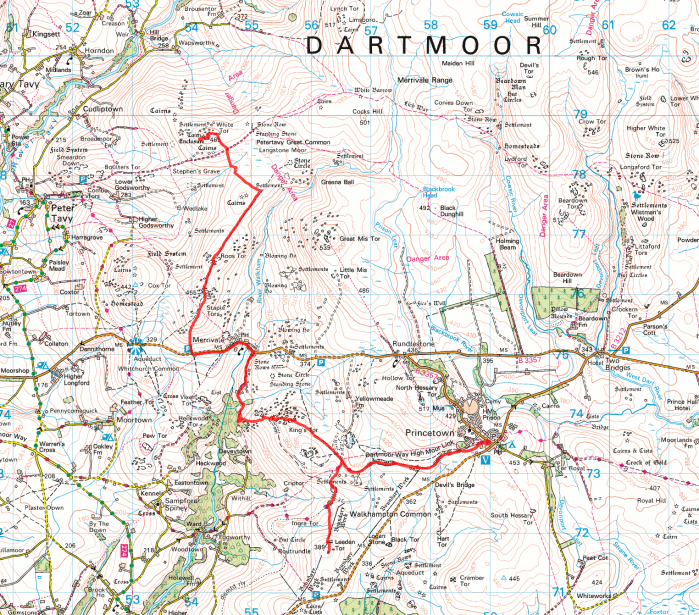
Day 1: Ivybridge to Left Lake
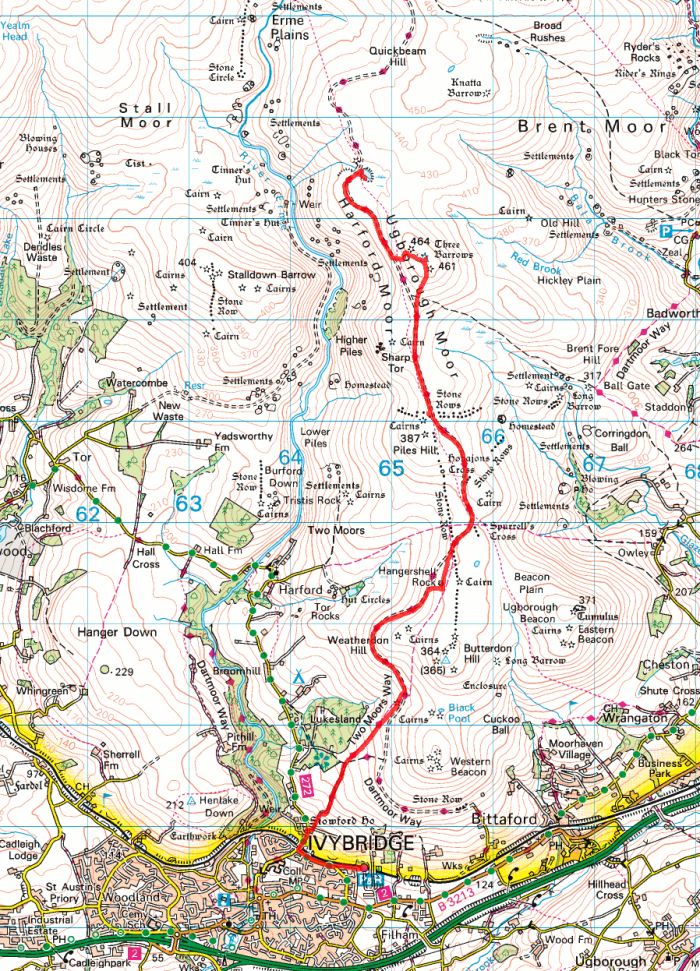
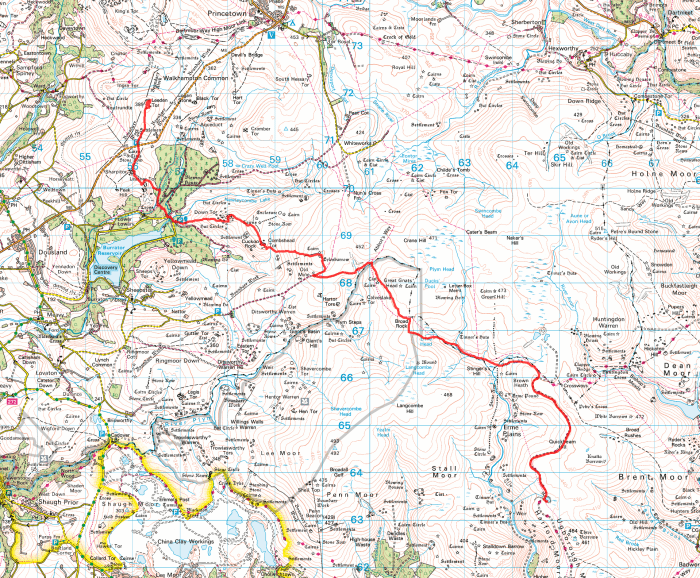
A stiff breeze blew right in my face as I walked along the road from Ivybridge station to join the Two Moors Way, which would take me up onto the Moor. An easy climb on first the road, then a track, and after the initial shock at the effort of hauling my carcass and loaded rucksack uphill after so long, I could actually feel some of the benefit of recent fitness gains.
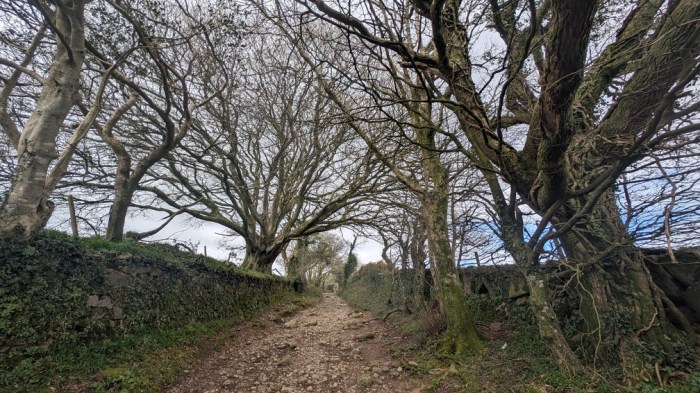
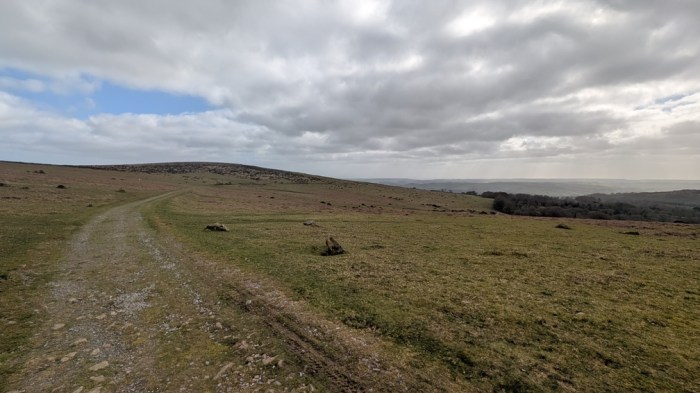
I stuck with the Two Moors Way as much as possible, it being the obvious and simplest way of making progress. I did detour off to visit Hangershell Rock, a great little tor, but which was far too early in the day’s walk to consider as my overnight stopping point, as well as not offering much in terms of respite from the wind.
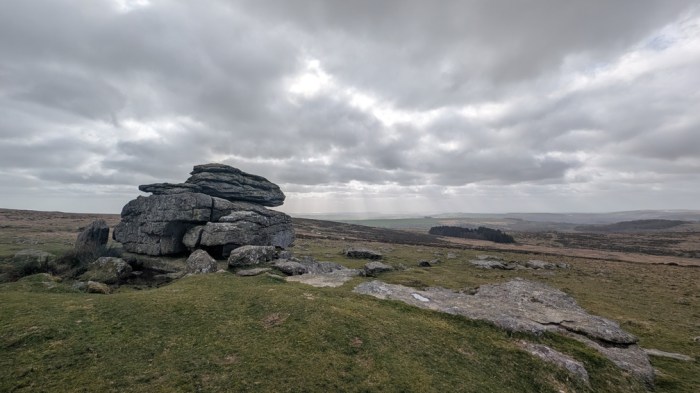
In any case my minimum target was Sharp Tor, but I didn’t bother with a detour as I could see very clearly that it wasn’t going to cut the wind much at all. I did pop up onto Three Barrows to see if one or more might provide some form of shelter at the same time as views, but no.
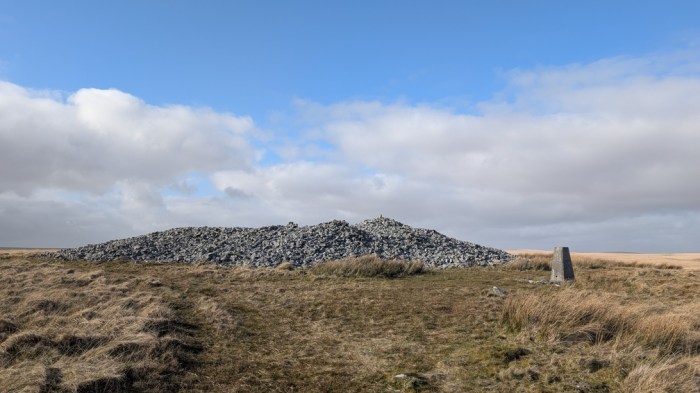
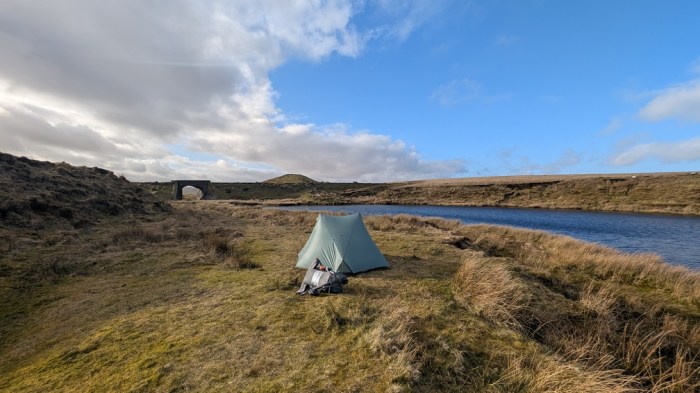
As I approached Left Lake, I spotted a patch of flattish ground where the grass didn’t seem to be moving overly in the breeze, and went to investigate. It wasn’t perfect, but seemed to keep me out of the worst of the wind, so I went for it.
Day 2: Left Lake to Leeden Tor
I woke to a shroud of mist surrounding the tent, which filled me with joy knowing that I’d need to do some actual proper navigating if it lingered far into the day. But it gradually lifted as I made progress along the track, and by the time I left the Two Moors Way below Western White Barrow, visibility was good.
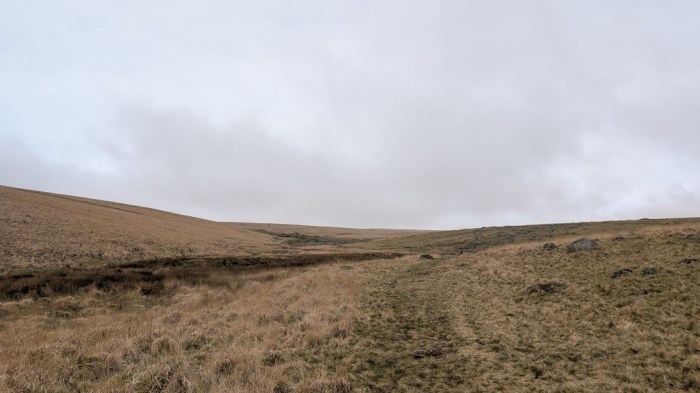
I cut away from the Two Moors Way to find the path up alongside the Erme, which I’d taken on my last visit.
As various sheep tracks opened up on the climb out of the Erme valley, I deliberately took a slightly different course to last time, but still ended up in the same place, rejoining the most obvious path at Broad Rock.
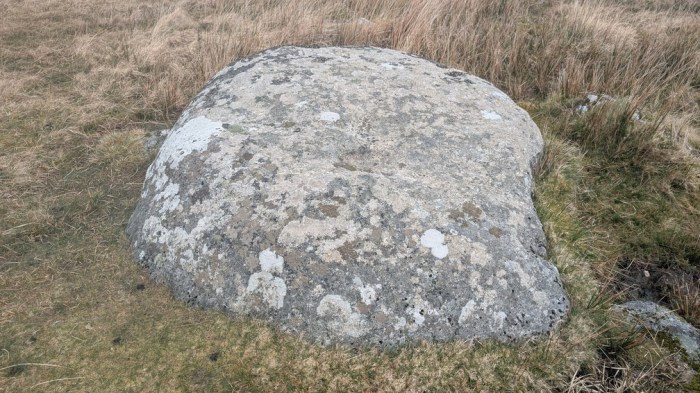
This time I actually stopped and saw the letters carved into the rock.
Just like last time, it was then a bit of a soggy trudge over the moor along the Abbots Way below Great Gnats Head to cross the Plym at Plym Ford. I sat here for a while filtering some water and stuffing snacks into my face while I decided what to do next.
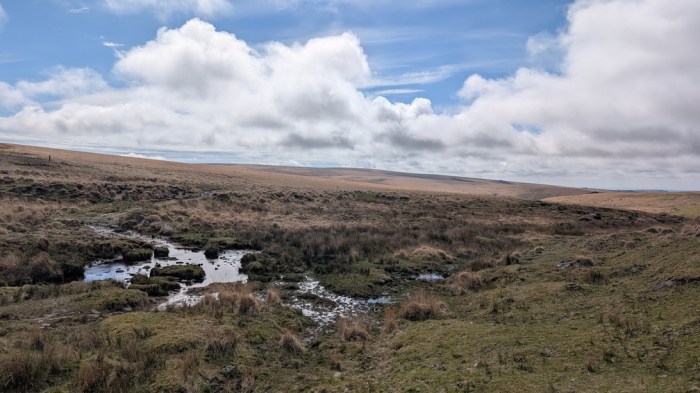
The issue now was thinking ahead to my overnight camp. I was just about to enter a patch of Dartmoor where the camping zone was a bit sparse, so I needed to either slow myself so I could stop before I left it, or push myself so I’d make the resumption of the zone. And at the same time, I wanted to call in at Princetown, either this afternoon or the next morning. Thus I didn’t want to be too far from Princetown.
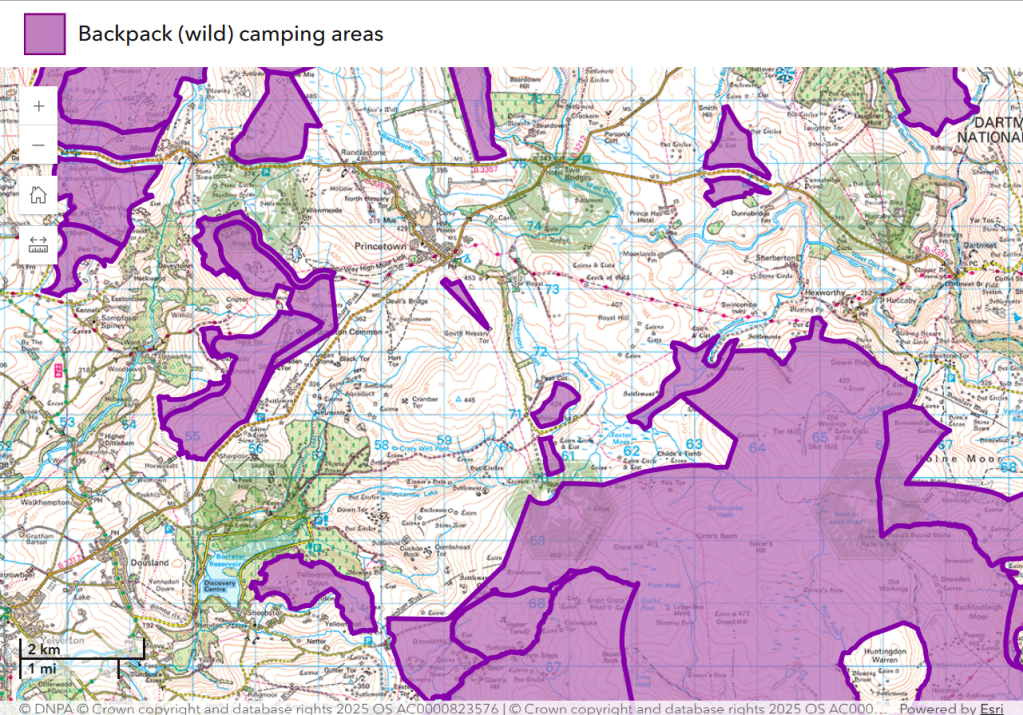
This meant that I kept stopping at each successive tor to have a think, constantly recalculating time available. So I stopped at Eylesbarrow, then at Combshead Tor (after a pretty maddening direct route from Eylesbarrow), and at Down Tor.
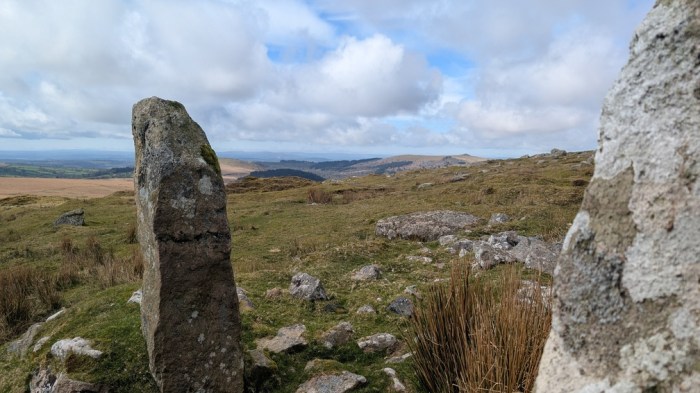
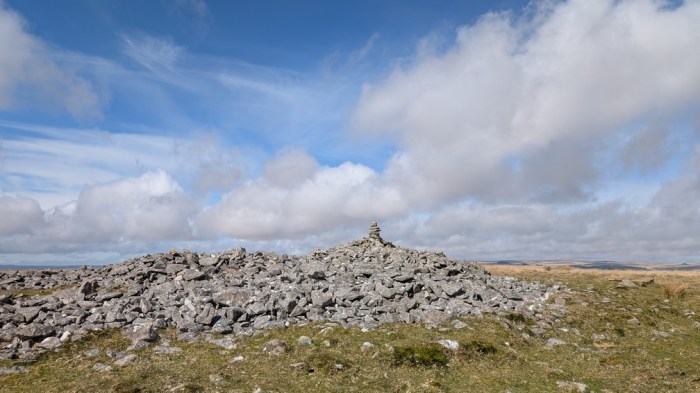
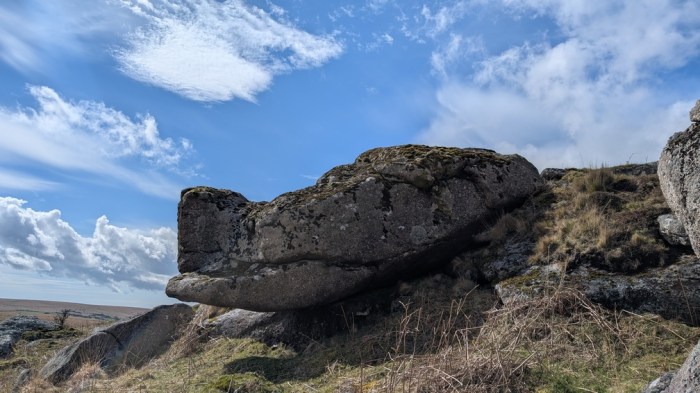
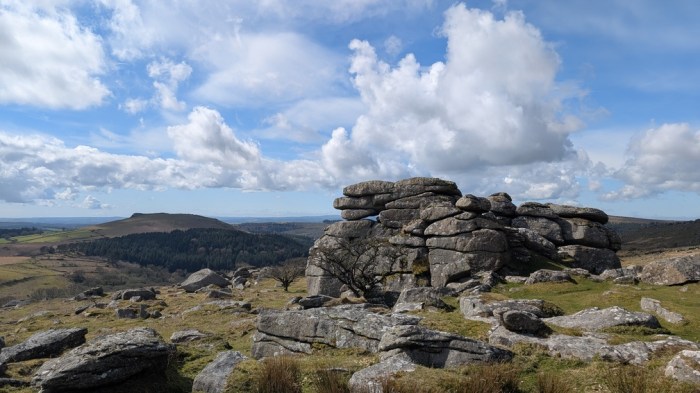
It’s never too much a hardship to have a good long sit on Down Tor though. At this stage I was thinking whether to really drag my heels and aim for Sheeps Tor for the night, or commit to either a big descent and reascent to get past Burrator or a tortuous route over pathless rough ground to maintain as much elevation as possible.
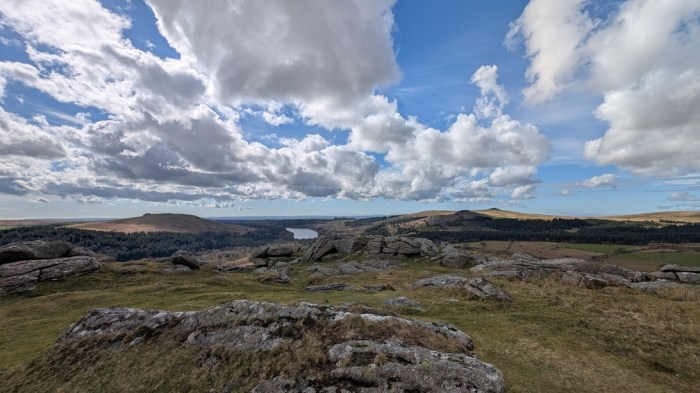
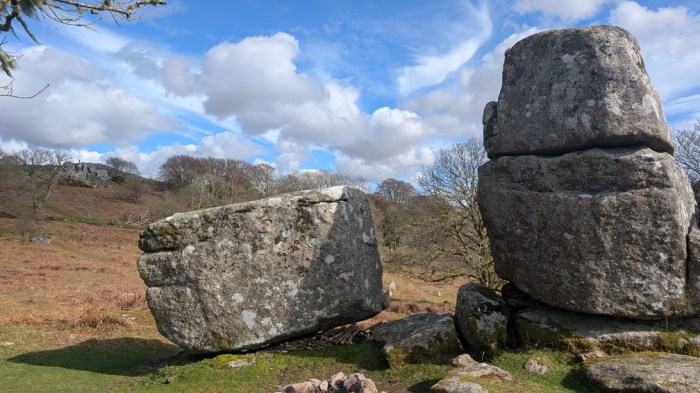
I chose the descent and reascent, and remembering the time I’d come down off Leather and Lower Leather Tors through a horrible brackeny mess, decided to find a way back up using the footpaths through the woods. Which worked really well. I picked up some water from the Devonport Leat before striking up through the forest to emerge onto the slope east of Leather Tor. No difficult ground, just a bit of an upwards slog late in the day.
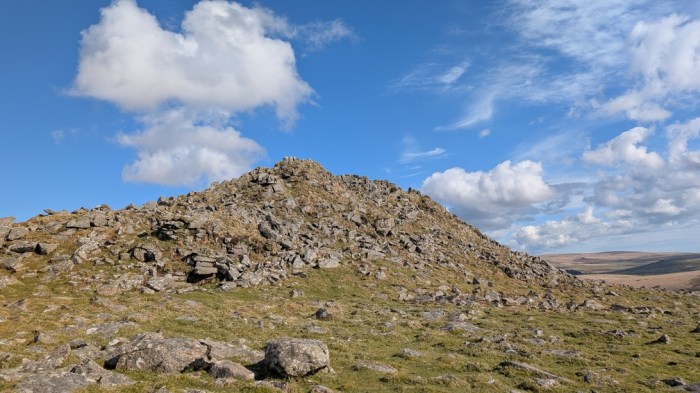
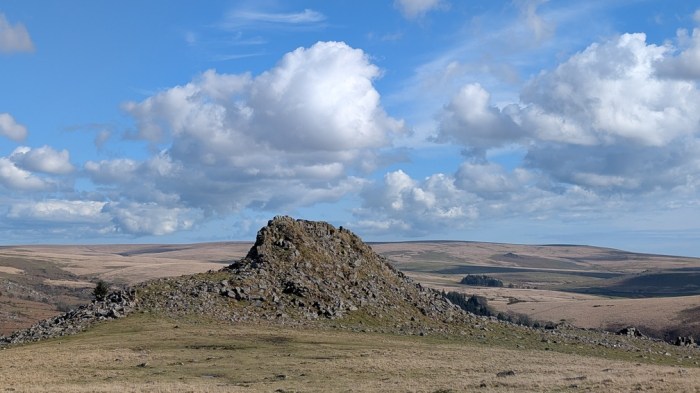
I topped out and walked over to Sharpitor. I just needed to get across the road and a little way beyond that the camping zone started again. I found myself a pitch in the vicinity of Leeden Tor, after much wandering around looking for a good combination of good ground and shelter.
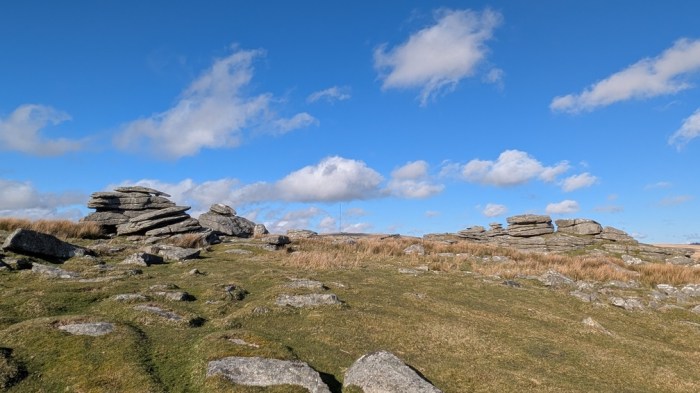
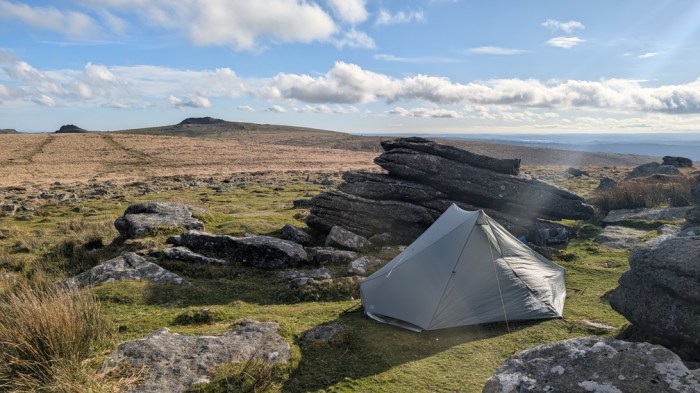
Day 3: Leeden Tor to White Tor (with a detour to Princetown)

…messaged Paul just as I was finishing packing up. Really!
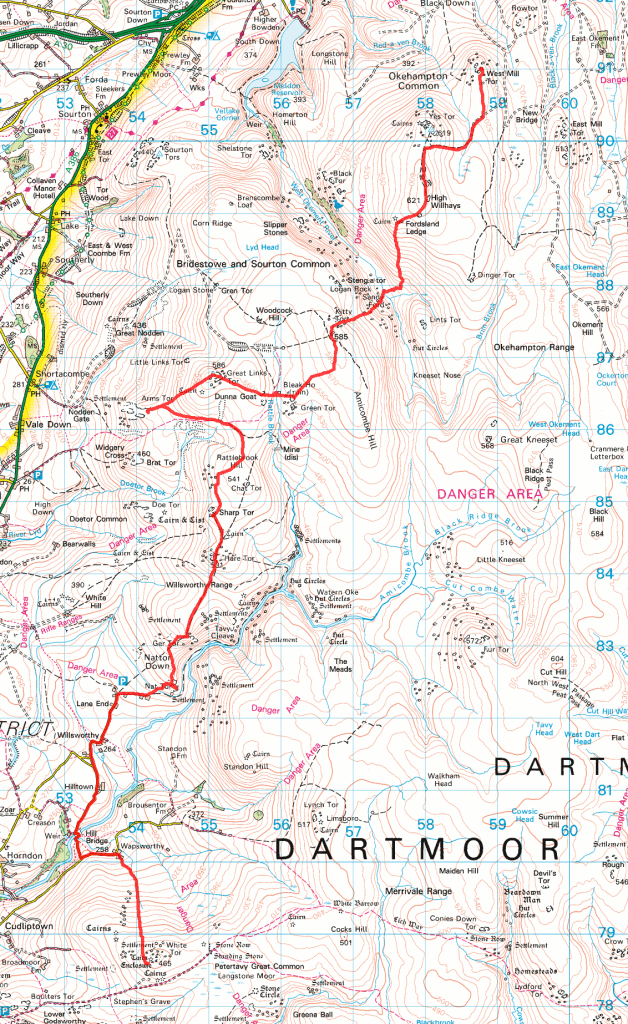
I took the easy way into Princetown, dropping down to the old railway by Yes Tor and Fur Tor (the Walkhampton ones not the big ones on the open moor further north). Then an easy 4km or so to breakfast in the Old Police Station cafe. I may have lingered a bit, taking full advantage of the coffee refill.
Eventually, though I needed to get going, and retraced my steps back out along the old railway, and continuing along onto King’s Tor.
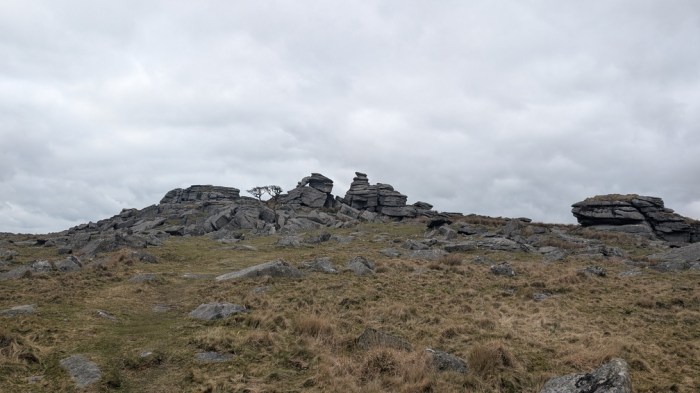
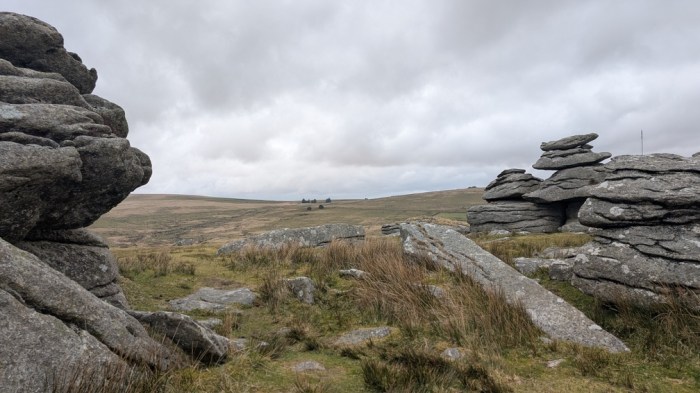
A brief break while weighing up making a beeline for the road, or a more interesting route, and I set off again, making for Hucken Tor on the edge of the woods above the River Walkham. I’m not usually one for tors in woodland, but Hucken is undeniably impressive.
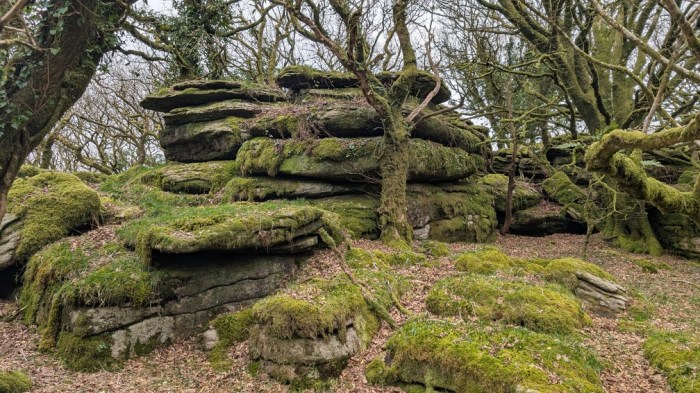
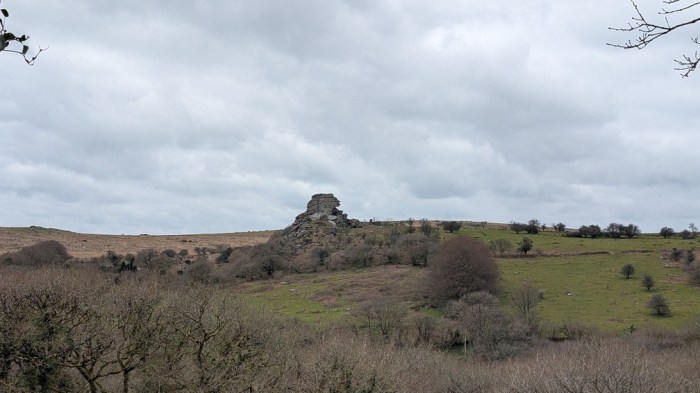
A decent bridleway brought me out to the road at Merrivale, and I used the verge as an easy way to climb back up out of the dip. I toyed with a detour to visit Pew Tor, my original plan had been to drop down to Sampford Spinney and climb up over Pew etc before striking north, but a desire to avoid that much descent knocked that off the menu. But I was feeling lazy, so even the easy walk over Barn Hill to Pew Tor, I couldn’t be bothered with.
Instead, I turned my face north and struck off and up for Great Staple Tor.
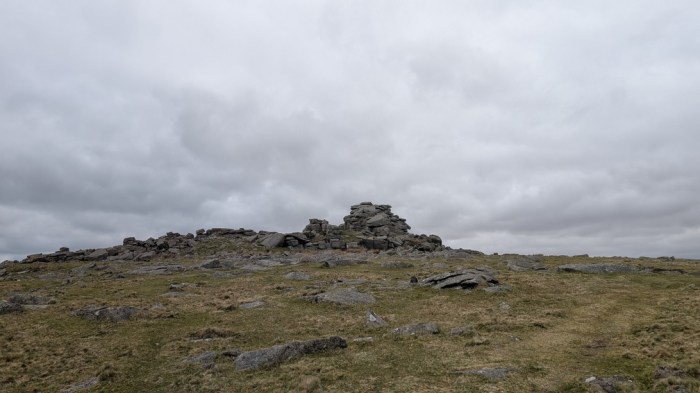
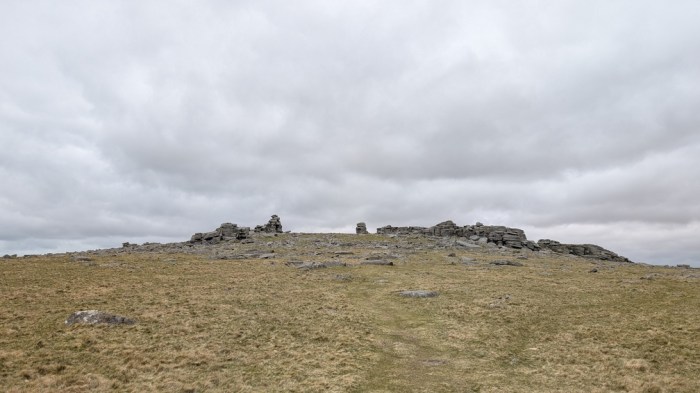
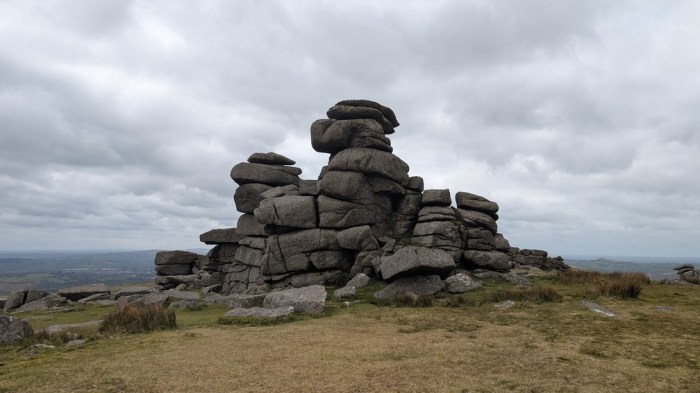
I stopped here for a good long break, getting the stove out to make a brew as well. Then it was off to Roos Tor.
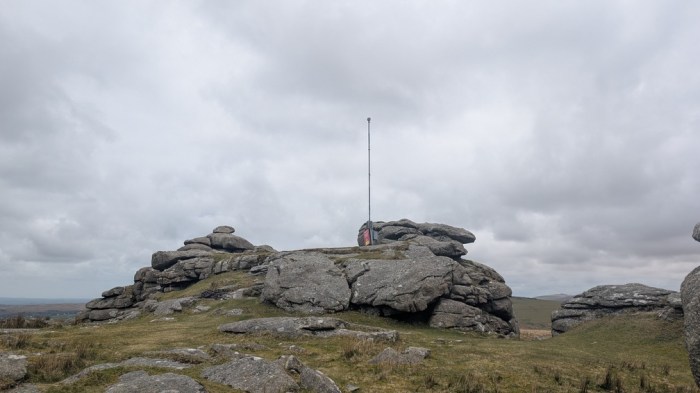
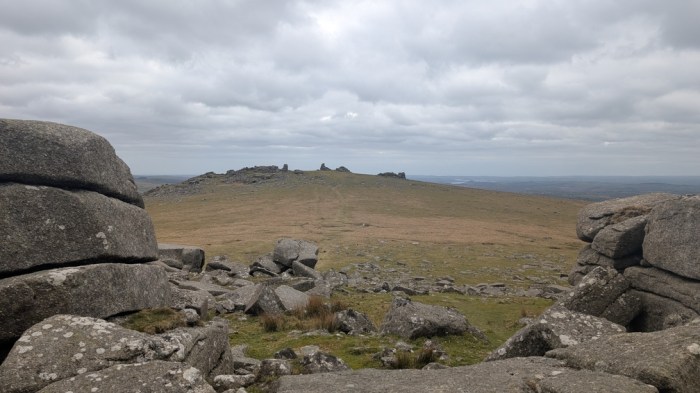
On the walk north from Roos Tor, I spent much of the time thinking about the best way to cut the corner around to White Tor, and in the end it just happened – a path opened up that headed almost directly for the fenced off area around the Colly Brook, and I simply followed it. It brought me right to the corner of the wall, and I couldn’t have planned it better. Also an opportunity to fill up with water, especially as I was pretty sure I’d stop at White Tor for the day, subject to finding enough shelter.
I climbed up and spent a while exploring the scattered rocky mess that is White Tor, before finding a pretty good pitch out of most of the wind. I sat down to enjoy the view of the early evening sun settling down beyond Cox Tor.
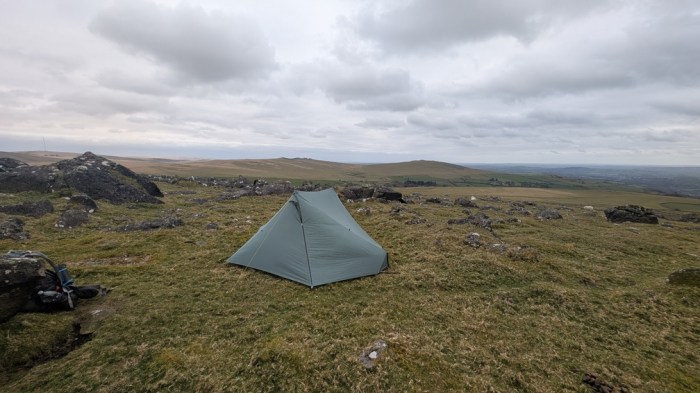
Day 4: White Tor to West Mill Tor
Lovely blue skies greeted me today, and lasted for much of the day. But when it turned….
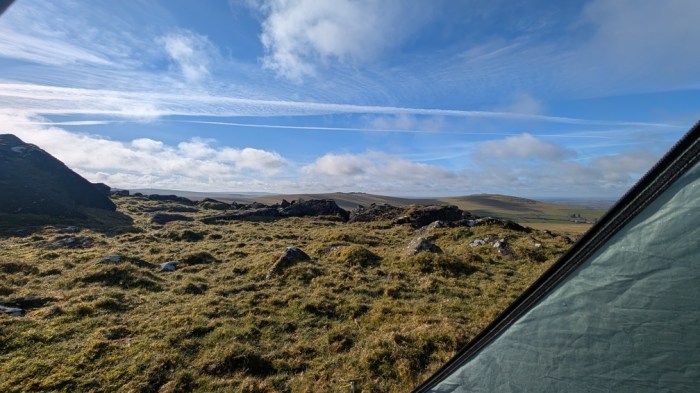
Another late start around 09:30, but what the hell I’m on holiday. That also meant I wasn’t liking my plan to skirt around to Tavy Cleave over the moor – a lot of distance when I could take a more direct route if I didn’t mind a bit of down and back up. Which at that point in the day, I didn’t.
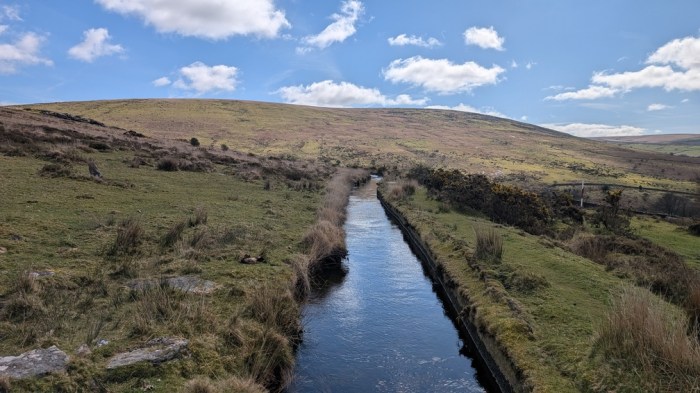
So I dropped down off White Tor to Wapsworthy, then followed the roads to Lane End. By the time I stepped off the tarmac and crossed over the open ground to Nat Tor, it was time for a break, a coffee break. So a brew was had sat there just chilling and looking up into Tavy Cleave.
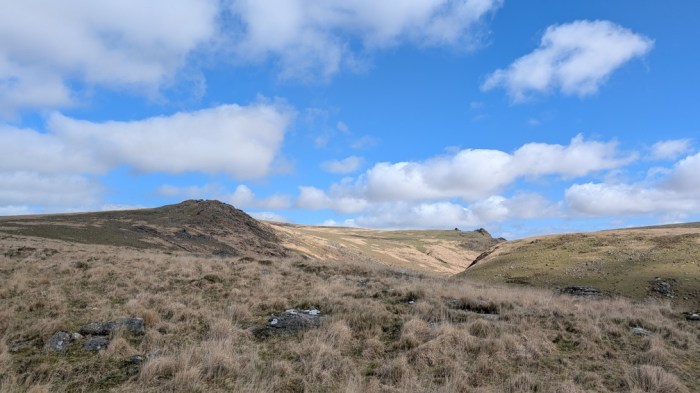
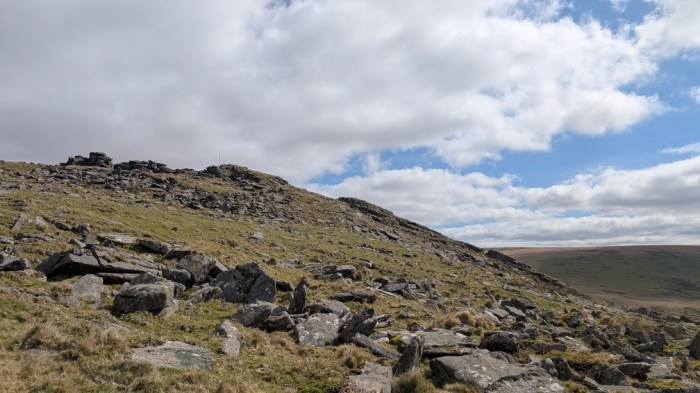
I paid for my leisurely start with what seemed like a stiff climb up to Ger Tor, but there was much worse than that to come. Having barely seen anyone on the moor for days, seeing 3 other people at the top of Ger Tor was a bit of a shock. We all did our own thing though, which in my case was wondering over for a better look into the Cleave.
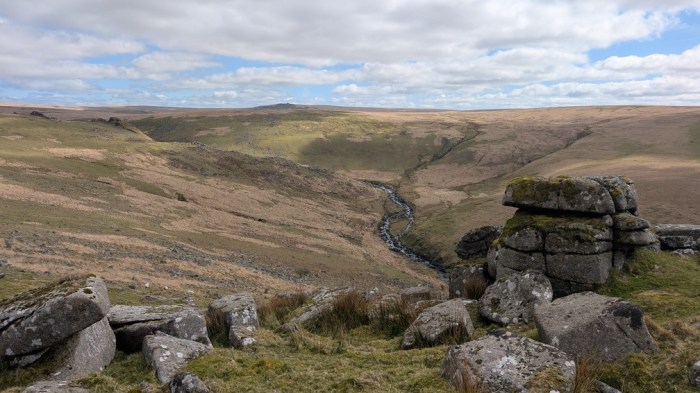
Next up was Hare Tor, which also had a leg sapping climb to finish off.
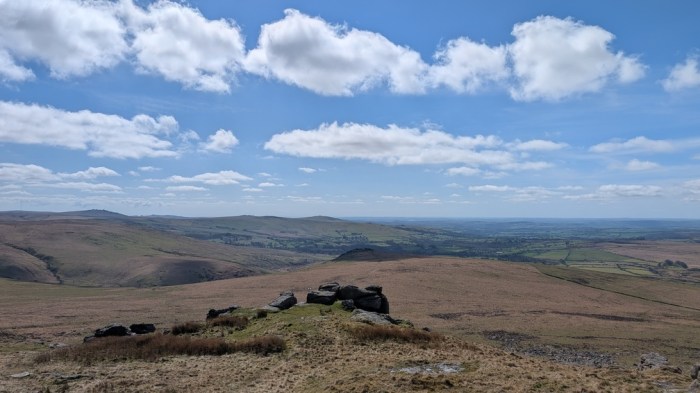
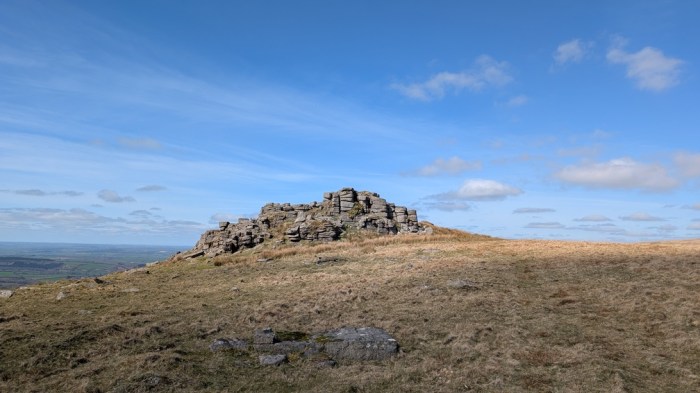
And then over to Sharp Tor, one of whose formations is a particular favourite of mine.
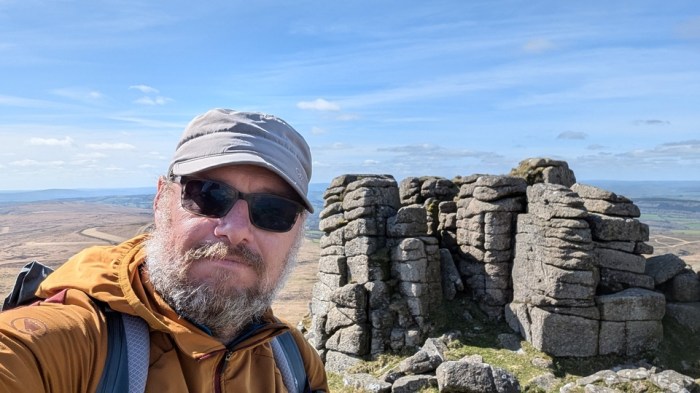
Now, unsure whether to head for Chat Tor and then towards the Dunnagoats en route to Great Links, or to take a more direct route, I chose the latter and ended up weaving all over the place as I tried to follow a variety of sheep tracks. I then decided to pop over to Arms Tor, which I could probably have reached more easily if that had been my initial objective.
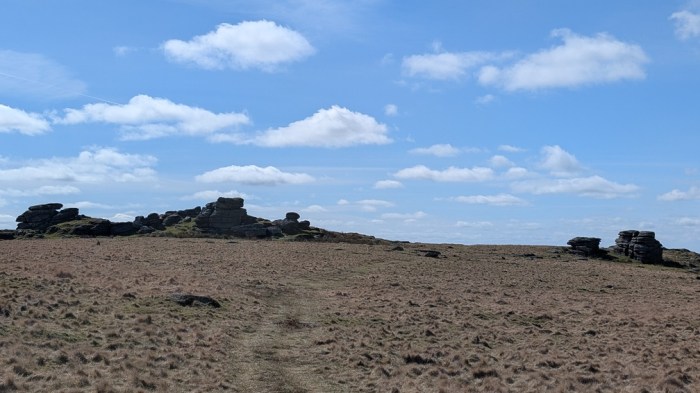
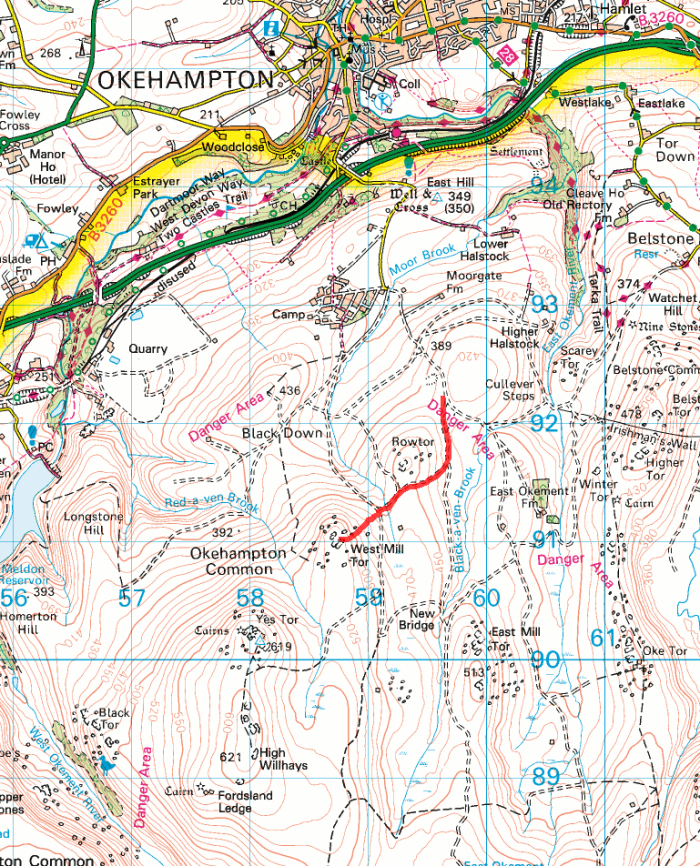
The detour to Arms Tor had cost me quite a lot of time, and I still had around 8km and 400m of ascent ahead of me, having made a tentative arrangement to meet Paul at West Mill Tor. This was the point at which the headphones came out to provide some additional musical motivation for the hard work ahead.
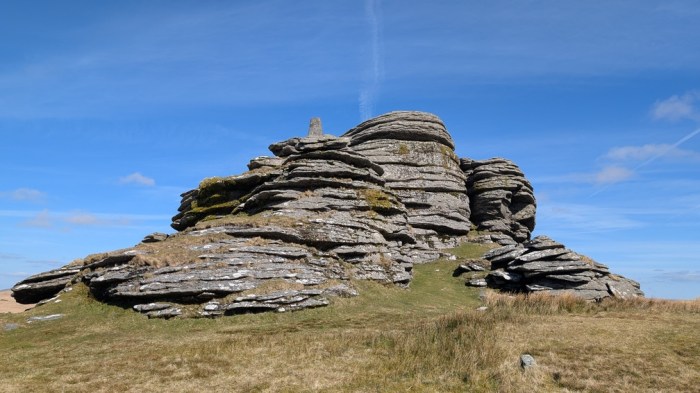
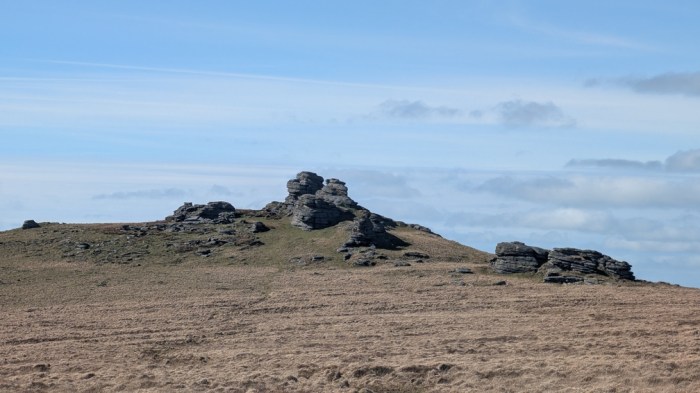
A slow grind up to Great Links, which I didn’t have time to enjoy as much as I would have liked. Pretty much straight on over to the Dunnagoats, then Bleak House and up to Green Tor, the barest of pauses at each for a sip of drink.
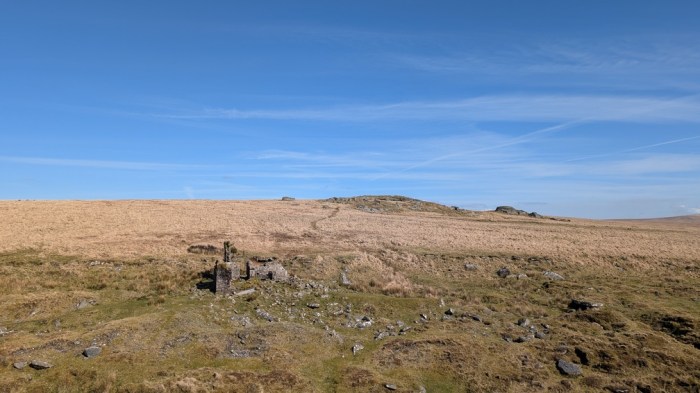
The route over to Kitty Tor was a bit tortuous with a lack of easy paths, and at one point I found myself having drifted over to the range poles, which were at least easy to follow and a semblance of a route that people had used before.
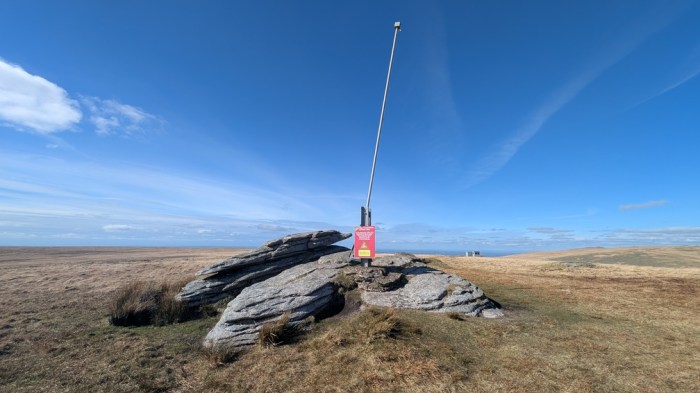
I got to Kitty and psyched myself up for the worst bit of the day’s walk: the descent straight down to Sandy Ford, which would then be followed by 250m slog straight back up the other side. Just what you want in the afternoon when you’re starting to feel a bit tired.
Plenty of care was needed on the way down to Sandy Ford due to various bits of eroded muddy path, but I made it and then had a lovely calf deep wade of the West Okement River.
A final pause to gird my loins for the big climb to the very top of Devon, then I set about the slog up to Fordsland Ledge and thence High Willhays.
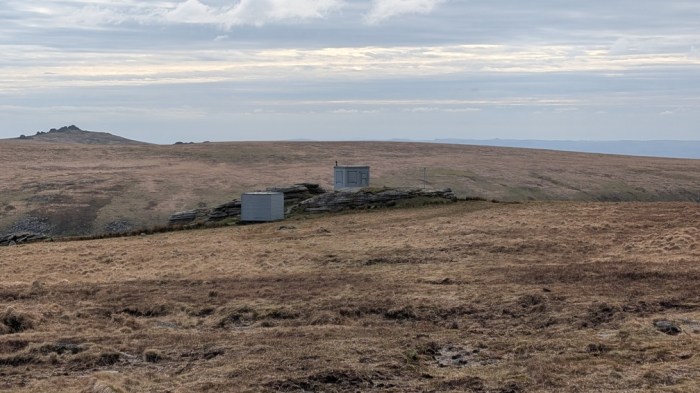
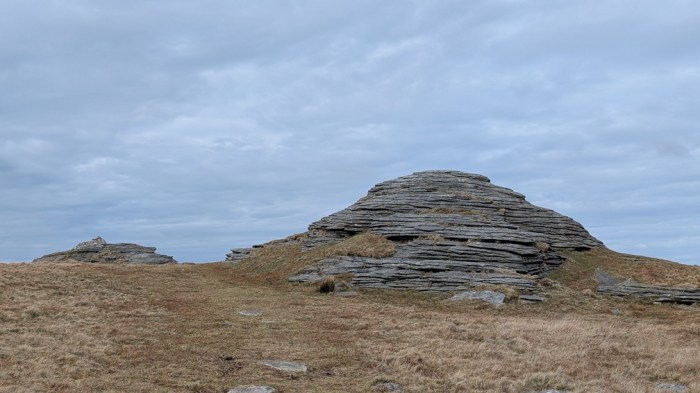
In the interests of time, I decided to skip Yes Tor, and to simply head down on the track before breaking off to walk over Little Tor to West Mill Tor. I knew exactly where I wanted to pitch, and as I approached I fervently hoped someone hadn’t claimed it already. By now the blue skies were gone, the sky had taken on a more threatening colour, and the wind had picked up. I’d felt too hot earlier, and now I was so cold I needed to keep moving.
I reached my spot, and although there was no one on the exact spot, there were a couple of guys not far away – pitched right in the full face of the wind – a bold choice I thought.
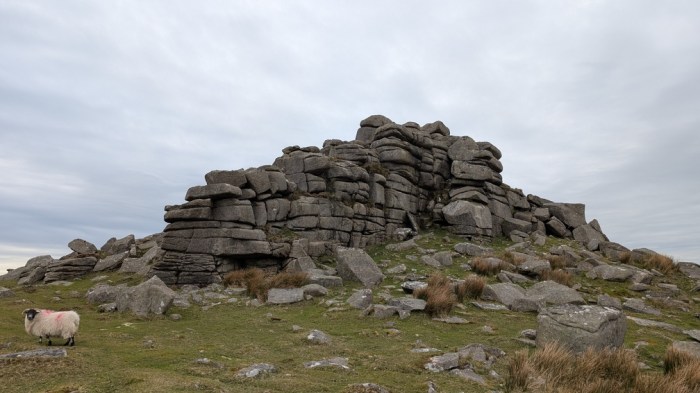
Ideally I’d have given them a bit more room, but I needed shelter and this was the last decent shelter before leaving the moor, so I went for it. Paul turned up soon after, bearing BEER, but not staying to camp.
After Paul had gone, I wandered over to say hi to the other guys, and we stood chatting for a while. Not for long though as the wind chill was brutal, and I wished them joy with their bold choice of exposed and bitingly cold pitch.
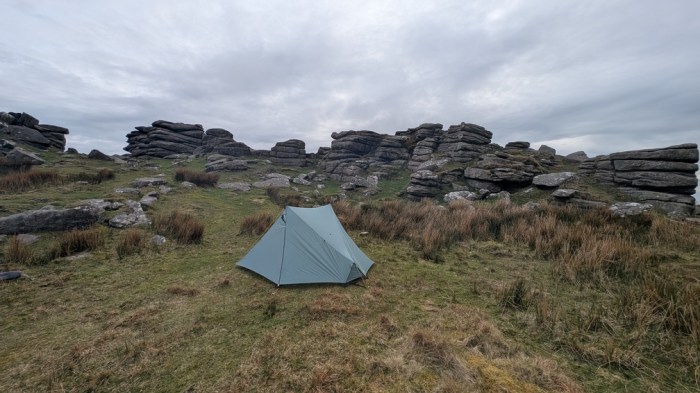
I settled down in the tent, struggling to get warm. With a plan to meet Paul for breakfast at Okehampton station, it would be an early start, so I turned in earlier than I had been…
An hour or so’s dozing later, and the wind was making its presence felt. Clearly it had moved around to have a bit more south in it, and it was now exploiting a gap in the rocks above, and smacking the corner of the tent heavily. Everything was blowing about in all sorts of odd shapes. Concerned about it, I lay awake and then felt the fabric above all loosen and collapse. Sh!t, the tent’s gone, I thought. I scrambled out of bed and contorted myself out of the inner to see if I could see without actually going out of the tent.
Sure enough, the pitchlok corner facing right into the wind was no longer staked. Indeed it had been lifted right off the stake, which was sitting exactly as I’d placed it. I looped the guyline back over it and tried to tighten as much as I could. I also grabbed hold of a second stake and put that in a small distance along to give it a better chance of holding.
But now, I was just waiting for it to go again…So sleep wasn’t going to happen.
Already thoughts were turning to a bail out, and as it was only just after 10:30 I knew Paul would likely still be up. I messaged him to begin to warm him up to the idea!
A bit of discussion, and then I called it. While I was packing up (I impressively for me managed to break camp fully in under half an hour), one of the trekking poles was knocked down by the contortions of the tent. And I knew I’d called it right.
Before setting off, I walked over to the guys nearby, lights on in at least one of the tents. I called out to ask if they were ok, and to let them know I was bailing. They were absolutely fine, despite being totally unsheltered. Clearly the effect of the wind tunnel was just affecting me.
It wasn’t fun dropping off West Mill Tor in the dark – a treacherous rocky patch of clitter being the main obstacle to overcome, at a time when the adrenaline was flowing and I just wanted off. Somehow I made myself slow down and focus on being careful, but there were several slides on the way. Then the ground levelled out somewhat and I found myself in a more sheltered patch, that would have done as a re-pitch location if I hadn’t had such an easy rescue available.
I hit the military tracks and it was just a matter of taking the correct turnings to end up at Rowtor car park, where Paul was waiting for an impromptu end to the trip.
A few thoughts and some words about gear
Once more, this trip showed that Dartmoor is as good a test of decision making as backpacking anywhere else can be. Being the first trip of the year, and the first substantial backpacking trip since doing the Perambulation last year, it would have been nice if I hadn’t had to think on my feet as I did. But that’s Dartmoor – it doesn’t always give you what you want.
I decided this trip would be a good opportunity to take the Stratospire to Dartmoor. Since buying it in 2024, I’d used it for 27 nights (somehow already making it my 3rd most used tent ever), but every single one of them had been in Scotland – it’s an ideal tent for the TGO Challenge. It should be more than capable of handling anything Dartmoor was likely to throw at it…
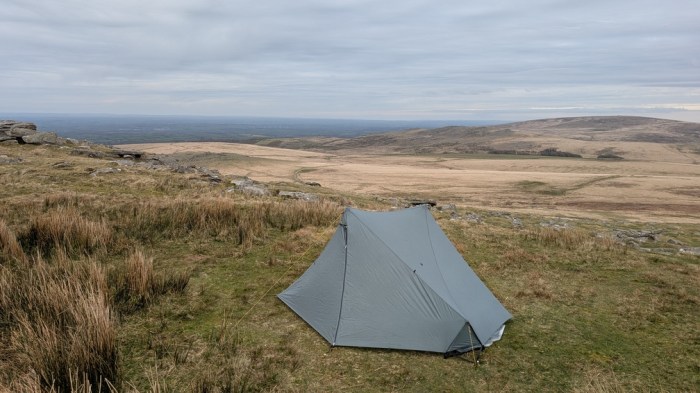
…except for that last night. I’d actually been sat in the tent on nights 2 and 3 just looking and listening to the tent in the wind, and been quietly satisfied with how it was handling things. Then night 4, in a supposedly sheltered spot, all hell broke loose. West Mill Tor did provide a good amount of shelter from the broadly westerly wind, not just from the force of it but from the wind chill too.
But then the wind veered (ok, technically the wind “backed” as it moved anti-clockwise, but veered sounds better and is more readily obvious what I mean to the non-meteorologist) round to the south west, and it came barreling through a gap in the rocks, hitting the Strat right on one of the pitchlok corners – generally thought of as one of the strongest parts of the tent. It probably didn’t help that the pitch was slightly raised anyway in that corner – this just made it even more inevitable that the wind thrashing about would succeed in lifting the corner off the tent peg, and collapsing that whole area.
I managed to put it back over the stake, and added a second one for good measure, which all seemed to be holding – but at that point I knew I wasn’t getting to sleep that night, as who could let themself go to sleep if there was a substantial risk that the tent could go again ? It was that that made me decide to bail – the collapse of the trekking pole happened after the decision had been made, and merely confirmed I’d made the right call.
I’ve plenty of instances in the past where an incident like this would be just enough for me to lose confidence in a shelter, and for it to quickly be sold on as a result. Indeed, I somehow managed to blame what happened on my 2018 TGO Challenge on my tent, and that was a medical condition!!! It so often has been the case that if I’m not having fun, I tend to make the tent in which I’m having that experience the scapegoat. But I don’t think that’s going to happen with the Stratospire – a tent I’ve already used enough to love it.
So, does this mean that the Stratospire can’t handle wind ? Not at all. It had done well the previous nights, and this one was one of those freak combinations of circumstances. If the forecast had been for the wind to die down in an hour or two, I may well have stuck it out, but every sign was that I would have to put up with that wind tunnel all night long.
The decision to bail when I had the option was an easy one on this the last night of the trip with only about 2 miles of easy walking until I would have been off the moor the next morning anyway. I was lucky I was able to get Paul to come out to rescue me, but I did pass over much more sheltered ground on the way down, that I could have used if I’d simply moved.
I did catch myself wondering what it would have been like if I’d been in the Scarp though.
Looking back, if I’d known I’d have had as windy pitches as it turned out I had, I may well have decided to take the Scarp, which has never failed me in such conditions. But what’s happened is I’ve had a really good test of the capabilities of the Strat, and perhaps more importantly an understanding of what I need to do with it in less than favourable conditions to be confident in its performance. Tarptent did used to say (before they discontinued it), that it was the tent from their range that performs best in the widest variety of conditions, and specifically that it performs well in wind.
Or to cut a long story short, what happened isn’t the fault of the tent – more a reflection of a less than ideal pitch and a wind whose effects were magnified by the surrounding features.
The real test of confidence in the tent will be if I decide to take the Strat to the Lakes when I finally get to go on that one….
Also on this trip, I wore my new Hoka Challenger 8 trail shoes, and they did a good job. So much so that I’m going to stick to my plan of using them for both hiking and trail running rather than have different shoes for each. I’m conscious that the lower leg problems I had towards the end of the TGO Challenge last year may well be due to me using a combination of zero drop shoes for hiking after a period of no hiking but lots of running in shoes with a drop.
The other new piece of gear on this trip was the Mazama MGO bottle. I’ve wanted one of these for a while, but wasn’t prepared to import one, so it was a delight when I found out that Valley & Peak are now stocking them. It worked well on the trip, albeit it was a bit large for my shoulder strap pocket, so I’ll be getting one of the smaller bottles as well when they come back in stock at V&P.
